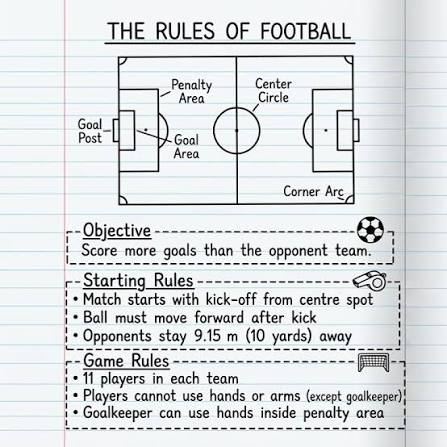
Football (soccer) is played by two teams of 11 players each, who aim to score by getting the ball into the opponent’s goal.
Players must use their feet, head, or torso to control and pass the ball, as using hands or arms during play is strictly prohibited except for goalkeepers inside their penalty area.
Matches are governed by the IFAB Laws of the Game, which consist of 17 core rules, broken down into the following key aspects of play:
Match Length: A standard match lasts 90 minutes, divided into two equal 45-minute halves. Stoppage time is added at the end of each half to compensate for substitutions, injuries, and delays.
Kick-off: Play begins with a kick-off at the center circle. Teams switch sides at halftime and the opposing team takes the second-half kick-off.
Scoring: A goal is scored when the entire ball crosses the goal line, between the goalposts and beneath the crossbar.
Out of Bounds: The ball is out of play when it fully crosses the boundary lines (touchlines or goal lines) on the ground or in the air.
Players & EquipmentRoster: Each team fields a maximum of 11 players, one of which must be the goalkeeper. A minimum of 7 players is required to start or continue a match.
Substitutions: Teams can typically make up to 5 substitutions per match across three substitution windows, excluding halftime.
Equipment: Standard mandatory gear includes a jersey, shorts, socks, shin guards, and cleats. Goalkeepers must wear a distinct color to differentiate themselves from outfield players and match officials.
Fouls & MisconductHandball: Outfield players handling the ball deliberately will result in a free kick or penalty. Accidental handballs resulting directly in a goal are also disallowed.Tackling & Fouls: Tripping, pushing, holding, or jumping
dangerously at an opponent results in a direct free kick or penalty.
Cards: The referee enforces discipline using yellow cards (for cautions) and red cards (for ejections). A red card can be shown for serious foul play, violent conduct, or receiving two yellow cards in a single game.
RestartsThrow-in: Awarded when the ball goes over the sideline. The opposing team throws the ball back into play using both hands from behind and over their heads while keeping both feet on the ground.
Goal Kick: Awarded to the defending team when the attacking team kicks the ball over the endline. The ball is kicked from anywhere inside the goal area.Corner Kick: Awarded to the attacking team when the defending team kicks the ball over
their own endline. It is taken from the corner arc.
Free Kicks: Divided into direct (you can shoot directly at the goal) and indirect (the ball must touch another player before a goal can be scored).
A player is in an offside position if they are closer to the opponent's goal line than both the ball and the second-last opponent
(usually the last defender) at the exact moment the ball is played to them. The offside offense is penalized only if the player becomes involved in active play,
interferes with an opponent, or gains an advantage from the position. Throw-ins, corner kicks, and goal kicks are exempt from offside rules.